The main objectives of the project are: (1) identification of operational taxonomic units (OTUs) or amplicon sequence variants (ASVs) of micromycetes and bacteria in soil samples collected under deadwood of different tree species and in background soils of broadleaved forests located in ecotopes of fluvio-glacial sands and cover loams, (2) analysis of physico-chemical and general microbiological characteristics of soils, sampled under deadwood of different tree species and in the background soils of broadleaved forests located on sands and loams, and (3) assessment of species and functional diversity of soil fungi and bacteria and analysis of relationships of microbiota diversity and composition with soil characteristics and soil sampling locations (in the background forest, in the windthrow area, under deadwood of different tree species, in different soil types).
In 2024, field work was carried out in the Kaluzhskie Zaseki State Nature Reserve. Soil samples were collected at two sites of the 2006 mass windthrow (on sands and on loams near the villages of Yagodnoye and Nagaya, respectively) and in two soil types (sod-podzolic with patches of grey forest soils and dark humus soils) at a site of old-growth forest on loams (formerly 8 quarter of the Yagodnoye forestry) (Fig. 1, 2).
For metagenome research, soil was sampled from the upper 5 cm of the mineral horizon A without litter into sterile bags using a sterilised spoon, which was treated with alcohol and burnt. After transport from the forest (not more than 3 hours after sampling), samples were frozen in a refrigerator at the Reserve's stationary station. Samples were transported to the laboratory in a cooler with refrigerants. Soil samples were also taken at all sites to analyse soil physical and chemical properties. Sampling was conducted under fallen tree trunks and at sites outside the trunks in triplicate: at a mass windthrow site on sand under the deadwood of five species of Quercus robur, Tilia cordata, Acer platanoides, Populus tremula and Picea abies; at a mass windthrow site on loam under the deadwood of four species of Fraxinus excelsior, Ulmus glabra, Acer platanoides and Picea abies and at the old-growth forest site in two soil types under the deadwood of Quercus robur (Fig. 3). A total of 63 soil samples were collected for metagenomic analysis.
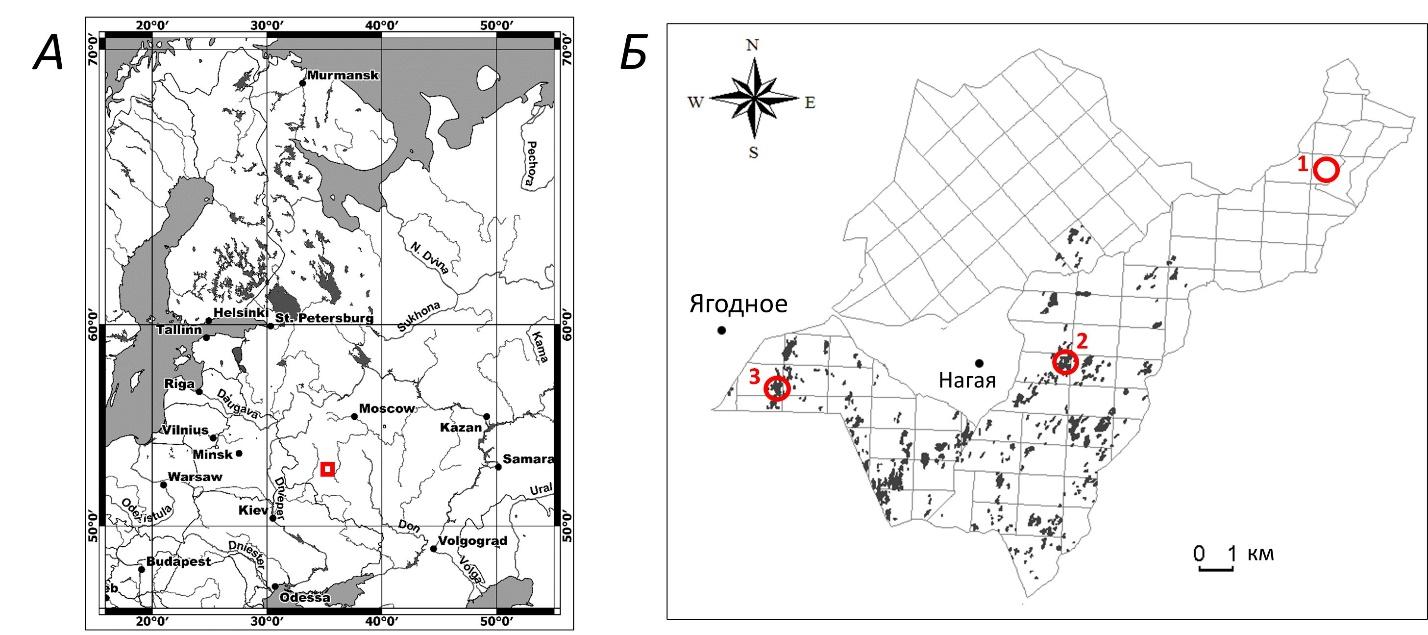
Fig. 1. Study area (A, red square) and study points (B, red circles) in the Southern section of the Kaluzhskie Zaseki Reserve: 1 old-growth forest (over 200 years old) with isolated windthrow on dark humus and sod-podzol soils, 2 mass windthrow of 2006 in broadleaved forest (70 years old) on sod-podzolic soils, 3 mass windthrow of 2006 in broadleaved forest (95 years old) on podzols. Black spots - areas of fallen forest stands during the mass windthrow in 2006.
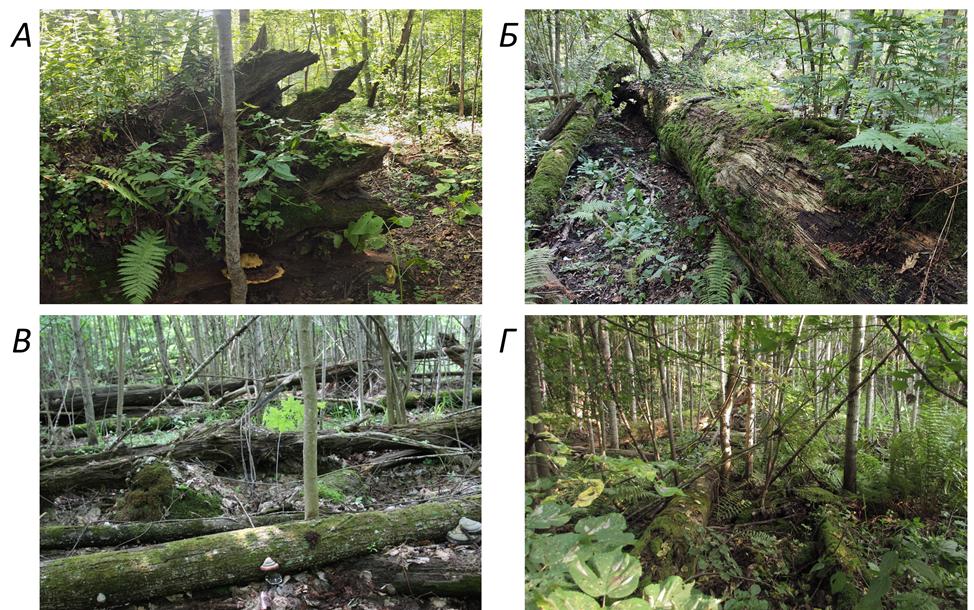
Fig. 2. Vegetation at the study sites: A and Б are single windfalls in old-growth broadleaved forest on dark humus and sod-podzolic soils, В and Г are mass windthrows of 2006 on podzols and sod-podzolic soils in 2020 and 2021
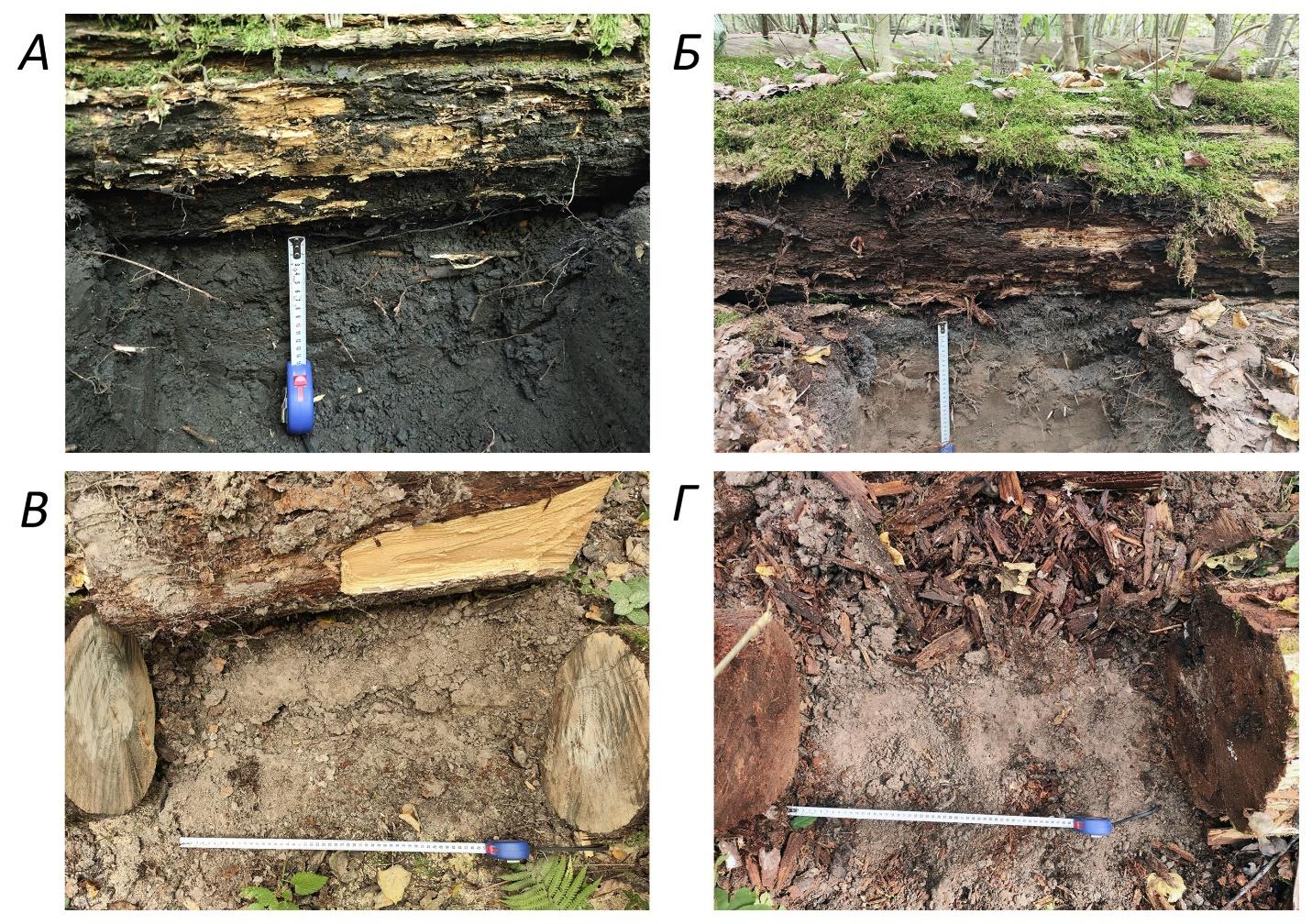
Fig. 3. Soil sampling locations: A and Б are under Quercus robur deadwood in old-growth forest on dark humus and sod-podzolic soils; В and Г are on sites of mass windthrow on sod-podzolic soil (under Fraxinus excelsior dead wood) and on podzol (under Picea abies deadwood)
Total DNA was isolated from soil samples using the Qiagen DNAeasy PowerSoil Pro kit (Qiagen, Germany). Amplification of fragments of the ITS3-ITS4 variable region of fungi and the V4 16S rRNA region of bacteria was performed using Q5 (NEB) polymerase. Quantification of isolated DNA and measurement of amplicon concentration were performed using a Qubit spectrofluorimeter using Qubit BR and HS 1X Assay Kit (Invitrogen, USA). The amplicons obtained will be used for library preparation and sequencing on the Illumina MiSeq platform.
Amplification was successful and amplicon concentrations were generally sufficient for further library preparation. In general, the concentrations of both fungi and bacteria were significantly lower in samples taken under deadwood than in samples taken in areas free of deadwood. This preliminary finding is consistent with our previous results for soil microbial activity (Khanina et al., 2022; Khanina et al., 2022; Smirnov et al., 2024; Smirnov et al., 2024), which decreased under deadwood on loamy soils. Bacterial and fungal concentrations between samples varied in a generally consistent manner: with an increase/decrease in bacterial concentrations, there was an increase/decrease in fungal concentrations. The highest concentrations of microorganisms were observed in sod-podzolic soils on loams, the lowest were in podzols on sands.
The project analysed soil characteristics in a mass windthrow area on loams: physical, chemical and microbiological characteristics, C and N stocks under deadwood of different tree species, near the deadwood and in the background forest outside the mass windthrow area were investigated (Khanina et al., 2024a). It has been shown that on cover loess-like loams the content and stocks of C, N, microbial activity (carbon of microbial biomass and microbial respiration), and soil moisture are maximum in the mass windthrow area free of overlying trunks. C, N reserves and microbial activity are higher in the windthrow than in the background forest. The species identity of fallen tree did not affect soil characteristics. Soil characteristics beneath the deadwood are close to those of the background forest. In the old-growth forest site, soils of different types (sod-podzolic and dark humus) did not differ in microbial activity, but significantly differed in N, C content, C/N ratio, content of mobile forms of P and K; these characteristics were higher in dark humus soils. Microbial activity of soils significantly decreased under deadwood, as well as C content and pH values (Khanina et al., 2024b; Smirnov et al., 2024).
The results of the research were reported at 5 conferences. Published an article in the Eurasian Soil Science, an article in the continuing edition, one dataset, 4 articles in conference proceedings.Press release about the project ‘Fallen Trees - Forest Pantry’ was published in the newspaper Poisk, on the RSF website and other media.