To assess the diversity of bacterial and fungal communities in soils of a broad-leaved forest following windthrow events, samples were collected from the upper 5 cm of the A horizon in four biotopes within the Kaluzhskie Zaseki Nature Reserve. Sampling was conducted at two sites affected by a mass windthrow in 2006: (1) a 100-year-old forest on sandy Podzols and (2) a 70-year-old forest on loamy Retisols. In addition, samples were collected from two loamy soil types in an old-growth forest characterized by isolated windthrows and oak trees older than 300 years: (3) Retisols and (4) dark humus soils (Phaeozems). Soil samples were collected from the following locations: beneath fallen tree trunks (deadwood) that were in an intermediate stage of decomposition and lay tightly on the soil surface, as well as from areas of mass windthrow without deadwood and from the background forest. At least three replicates were taken per site, with deadwood species considered, resulting in a total of 63 samples. Soil was collected under the trunks of seven tree species: Acer platanoides, Fraxinus excelsior, Populus tremula, Tilia cordata, Ulmus glabra, Quercus robur, and Picea abies. Soil samples were collected using sterilized instruments into sterile bags, frozen at -20°C and transported to the laboratory in a cooler without thawing.
Total DNA was extracted from each soil sample. Using standard primers, variable regions of V4 16S rRNA of bacteria and ITS of fungi were amplified. Next, DNA libraries were created and sequenced at Skoltech's Genomics Centre on Illumina MiSeq (Illumina, USA). The relative content of bacterial and fungal DNA in 63 samples was determined by quantitative PCR on a DT-lite device (DNA-Technology, Russia). After sequencing, bioinformatic analysis of fungal and bacterial communities was performed. The taxonomic affiliations of amplicon sequence variants (ASVs) were determined based on reference sequences from the GreenGenes2 database (McDonald et al., 2024) for bacteria and using a classifier in the UNITE database (Abarenkov et al., 2024) for fungi. A total of 19,287 unique ASVs of bacteria (60 samples) and 1,565 ASVs of fungi (57 samples) were detected in the soil samples.
Alpha and beta diversity metrics were calculated. We tested the hypotheses that the content and diversity of soil microbial communities are influenced by (1) soil particle size distribution and biotopes, (2) windthrow mass, including deadwood and areas outside deadwood, compared to background forest without deadwood; (3) fallen tree trunks compared to areas outside the deadwood area, and (4) the species affiliation of fallen trunks. We assessed the significance of differences in relative DNA content, alpha diversity indices, and ASV composition of bacteria and fungi between sample groups using ANOVA and PERMANOVA analyses.
Results of metabarcoding analysis
The relative content of bacterial DNA was higher in samples taken from loamy soil than in samples taken from sandy soil, and conversely, the content of fungal DNA was higher in sands (Fig, 1). The relative content of bacterial DNA was lower in samples taken under tree trunks than in samples taken in areas free of fallen trunks. The maximum bacterial DNA content was observed in Phaozems of old-growth forest in areas without deadwood. The relative fungal DNA content was highest in Podzols under fallen trees (especially under spruce trunks) and lowest in loamy soils.
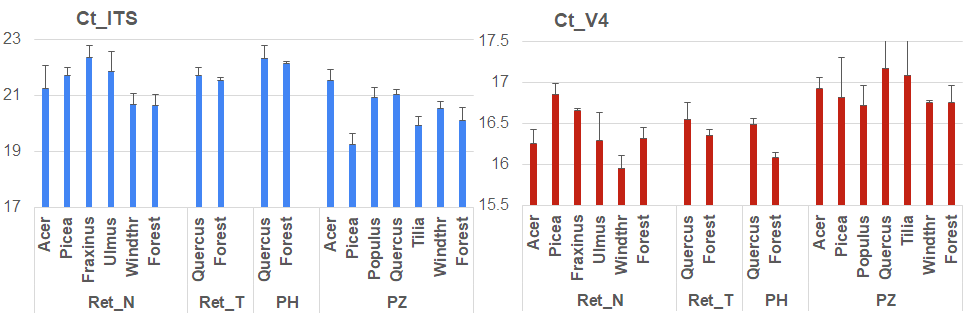
Fig. 1. 1. Number of doubling cycles of PCR required to obtain a detectable signal for fungal DNA (Ct_ITS) and bacterial DNA (Ct_V4). Lower values correspond to higher target DNA content. Forest is background forest, Windthr - area of mass windthrow without deadwood
Profiling microbial communities using 16S rRNA sequencing showed that the studied soils of 70-, 100- and more than 300-year-old forests are characterized by a high abundance of bacterial groups involved in carbon, nitrogen, phosphorus, and sulphur cycles, as well as in rhizosphere functioning. The main group of bacteria in the studied forests is Alphaproteobacteria, primarily the Order Rhizobiales, whose representatives are associated with the rhizosphere and play an important role in the nitrogen cycle (Fig. 2). The composition of the dominant Classes – the predominance of Alphaproteobacteria and Verrucomicrobiae, as well as Planctomycetia in sandy soils – distinguishes the soils of the Kaluzhskie Zaseki from most other forest soils studied in the literature, primarily due to the small proportion of acidobacteria and actinomycetes.
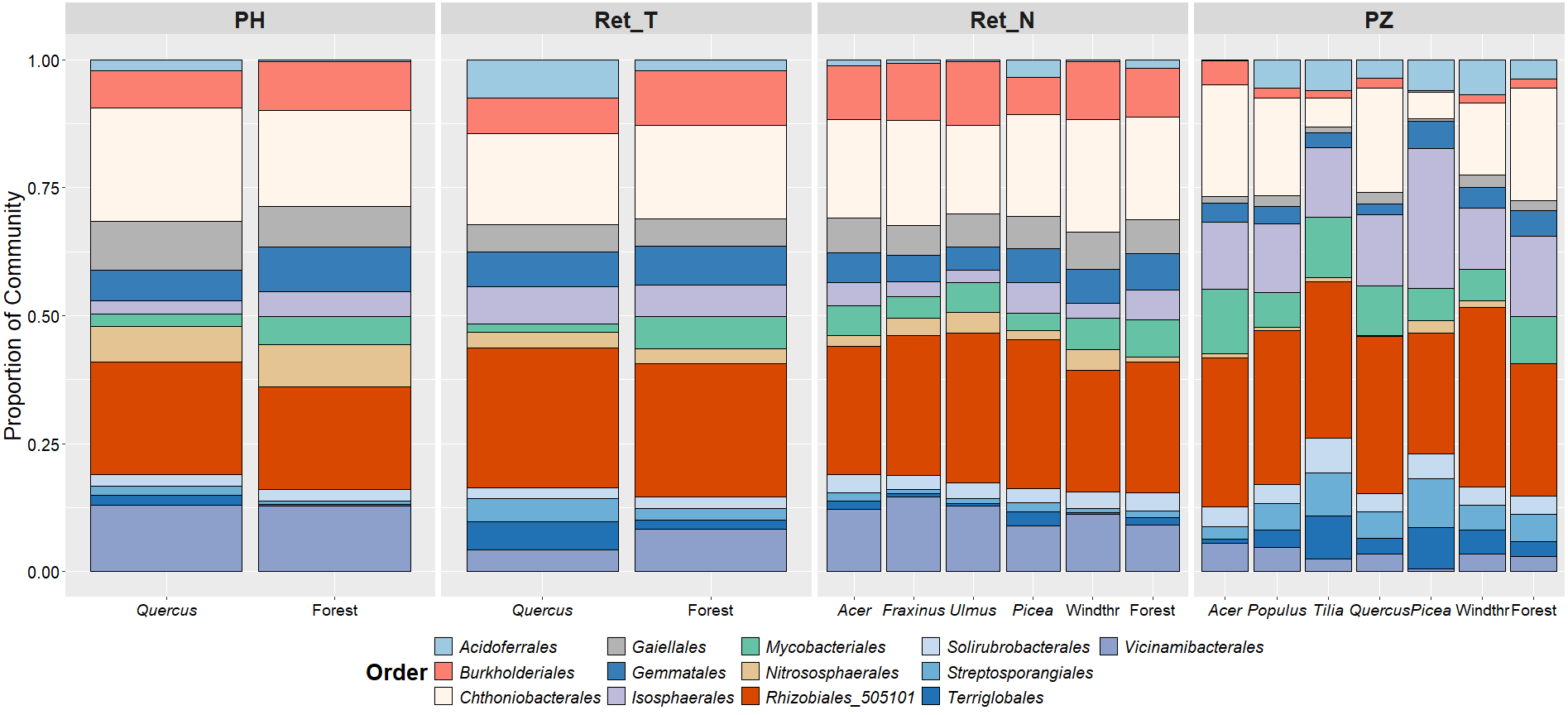
Fig. 2. Taxonomic composition of bacterial communities at the Order level in the soil of various biotopes and microsites of the Kaluzhskie Zaseiki Nature Reserve, averaged by replicates and repetitions
Profiling fungal communities by sequencing the ITS region showed that a notable feature of these communities is the absolute dominance of ascomycetes with very little participation of other phyla (Fig. 3). Saprophytes predominated in Phaozems and Retisols. Ectomycorrhizal fungi dominated only in the background forest on Podzols; their share is also significant in the soils of other sites on Podzols, with Cenococcum, the most common monotypic genus of mycorrhizal fungi, predominating. The greatest richness of fungal ASVs was observed in Phaozem communities, where the minimum number of dominant Genera was also observed: Penicillium, Oidiodendron and Helotiales, which indicates high intrageneric diversity in these communities.
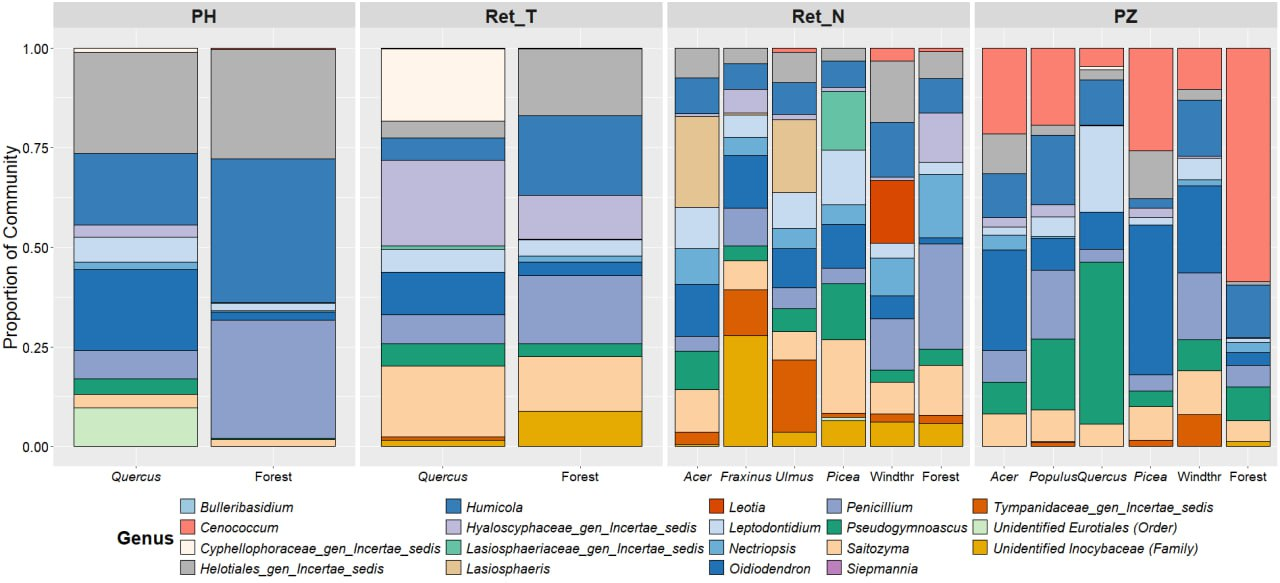
Fig. 3. Taxonomic composition of fungal communities at the Genus level in the soil of various biotopes and microsites of the Kaluzhskie Zaseiki Nature Reserve, averaged by replicates and repetitions
In terms of community structure, diversity and bacterial and fungal DNA content, the most significant differences were observed between communities in soils of different texture: in sands (Podzols) and loams (Retisols and Phaozems). Despite the higher relative content of fungal DNA in sandy soils, loamy soils have significantly higher alpha diversity in both bacterial and fungal communities (Fig. 4, 5). The results confirmed the hypothesis of a significant influence of fallen wood on microbial communities in forest soils. The impact on the bacterial community is very diverse, depending on both soil properties and the species of fallen tree. At the same time, the structure of bacterial communities at the high-frequency orders is quite conservative and does not vary greatly between sites within the biotope. The most noticeable changes in community composition occur under fallen trees with specific wood properties, such as Quercus robur, Picea abies, Acer platanoides. - in particular, the low pH of oak and spruce wood and the high pH of maple wood. A large number of unique taxa, accounting for more than half of the total number identified in the ASV study, were observed under deadwood and in areas of mass windthrow without deadwood. The presence of deadwood from different tree species and windthrows, leading to changes in environmental conditions, significantly increases the bacterial and fungal diversity of forest soils. The preservation of coarse woody debris during forest exploitation contributes to the conservation and maintenance of soil biodiversity.
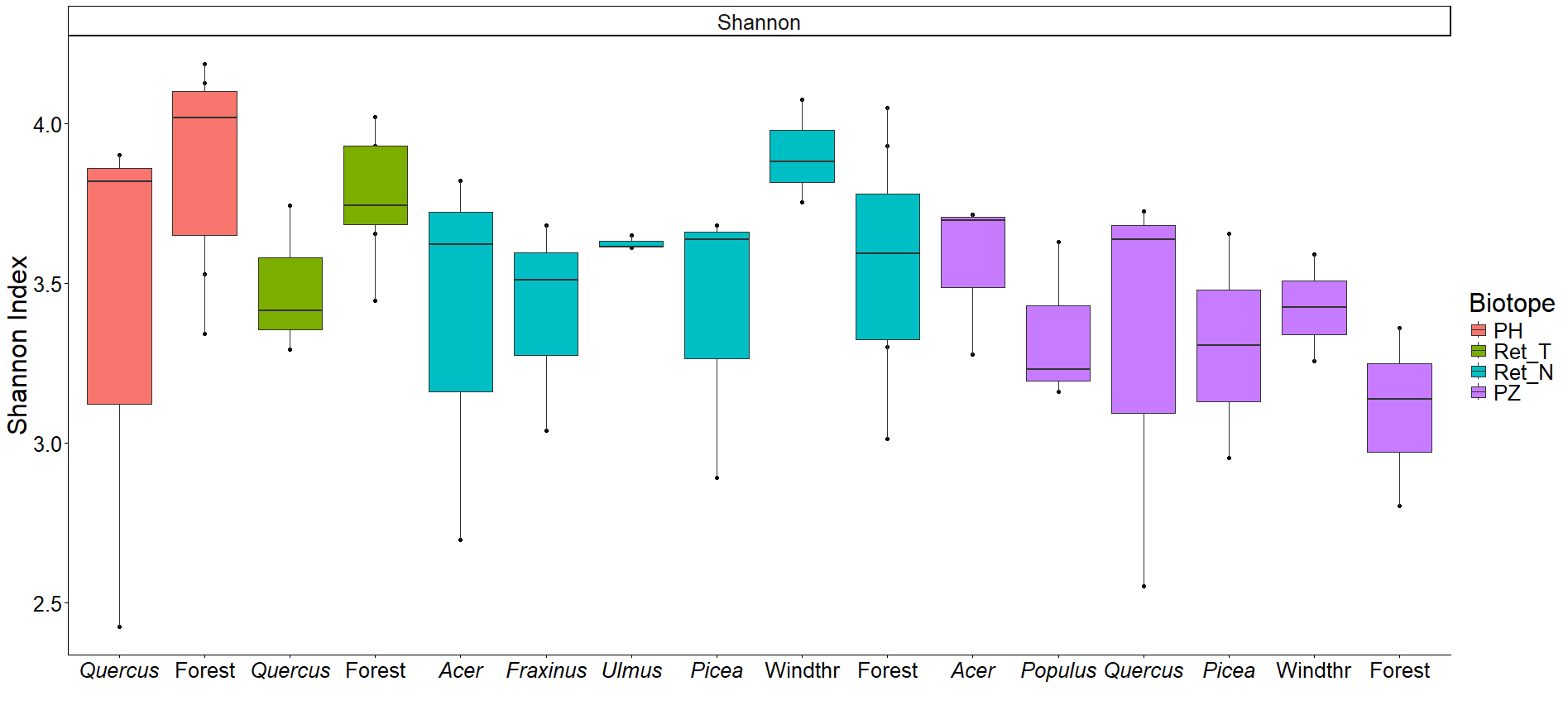
Fig. 4. Alpha diversity of bacterial communities in the soil of various biotopes and microsites of the Kaluzhskie Zaseki Nature Reserve
Physical and chemical soil characteristics were also studied during the project at locations of mass and isolated windthrows (Khanina et al., 2024, 2025; Smirnov et al., 2024).
The presence of deadwood from different tree species and windthrows, leading to changes in ecological conditions, fundamentally increases the bacterial and fungal diversity of forest soils. The creation of multi-species forest plantations with coarse woody debris (CWD) and stands of different ages, contributes to increasing the ability of forests to sequester carbon, preserve biodiversity and implement the principles of a low-carbon economy. When planning forestry activities, it is important to retain CWD in forest and maintain uneven-aged structure of mixed-species stands, as these elements increase the resilience of forests to climate change and contribute to long-term carbon accumulation.
The results of the study were presented at eight conferences. Six scientific articles were published. A press release about the project ‘Fallen Trees – Forest Storehouse’ was published in the newspaper Poisk, on the RSF website.
List of main publications:
- Khanina L.G., Ivashchenko K.V., Smirnov V.E., Bobrovskii M.V. Carbon and nitrogen stocks and microbial activity of the humus horizon of loamy soils after mass windthrow in the broadleaved forest of the Kaluzhskie Zaseki Nature Reserve // Eurasian Soil Science. 2024. V. 57. No. 11. P. 1806–1818. DOI: 10.1134/S1064229324601720
- Khanina L., Bobrovsky M. Changes in soil texture under deadwood in broad-leaved forests // Russian Journal of Ecosystem Ecology. 2024. V. 9. No. 4. DOI: 10.21685/2500-0578-2024-4-1
- Saveliev D.S., Shelyakin P.V., Tutukina M.N., Bessonova T.A., Bobrovsky M.V., Khanina L.G. The influence of fallen trunks of different tree species on the content and diversity of soil bacteria in broad-leaved forests of the Kaluga Zaseiki Nature Reserve // Molecular Biology. 2026. V. 60. No. 4.
- Khanina L.G., Bobrovsky M.V., Smirnov V.E. Carbon and nitrogen stocks in deadwood and soil after mass and isolated windthrows in broadleaved forests of the Kaluzhskie Zaseki Nature Reserve // Russian Journal of Ecology. 2026. Vol. 56. No. 6.
- Smirnov V.E., Khanina L.G., Ivashchenko K.V., Bobrovsky M.V. Assessment of the impact of large fallen oak trunks on soil properties based on statistical models with mixed effects // Proceedings of the International Conference ‘Mathematical Biology and Bioinformatics’. Edited by V.D. Lakhno. Volume 10. Pushchino: IMPB RAS, 2024. Article No. e52. DOI: 10.17537/icmbb24.54.